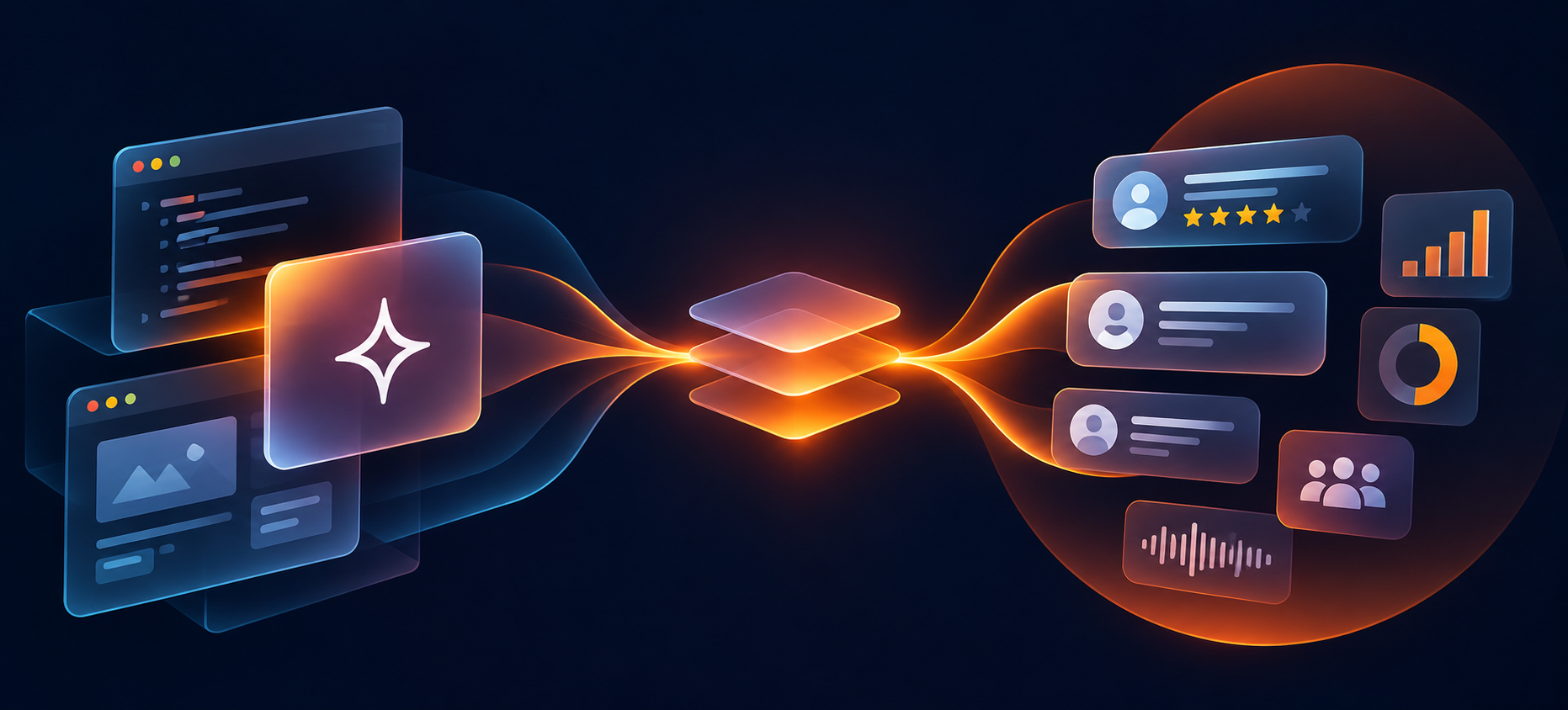
AI is changing how products get built. Here's how to keep customers in the process.

AI is making it easier than ever to move from idea to prototype. But building something quickly doesn't mean you've built the right thing.
Product teams still need to understand what customers need, where they struggle, and whether the experiences they're creating actually work for them.
Our latest capabilities offer new ways to bring human insight into that process—from uncovering the why behind customer feedback to using that feedback in AI-powered workflows and evaluating the human experience of AI itself.
Here are three ways to put them to work.
1. Go beyond the first answer with AI Moderation
Imagine your team is developing a new AI-powered customer support experience. A participant completes a task and says, "That was a little confusing."
It's useful feedback, but it leaves important questions unanswered. What was confusing? What did they expect to happen? What would have helped?
In a traditional unmoderated study, you might not get those answers unless you anticipated the right follow-up questions.
With AI Moderation, you can explore more of the why behind a response.
AI Moderation asks relevant follow-up questions based on participants' responses during verbal-response tasks in a New Think Out Loud study.
That means teams can uncover more of the reasoning, hesitation, and expectations behind customer feedback, at scale. With follow-up questions happening automatically across unmoderated sessions, teams can gain a deeper understanding of customer needs without having to moderate every session live.
Put it into practice: Before your next product evaluation, identify one assumption your team is making about customer behavior. Maybe you believe users will understand a new navigation pattern or know what to do after receiving an AI-generated recommendation.
Use AI Moderation to explore not just whether they succeed, but why they make the choices they do.
2. Bring customer feedback into the AI tools where you're building
AI-powered tools are making it easier to move from an idea to a working experience. But the ability to create quickly doesn't tell you whether you've created the right thing.
Imagine your team uses AI to develop a new customer support assistant. The experience looks polished, and the functionality works. Before moving forward, you want to know whether customers understand its responses, where they hesitate, and what might prevent them from completing their tasks.
With the UserTesting MCP Server, product teams can bring real customer feedback directly into AI-powered workflows in tools such as Claude, ChatGPT, Figma Make, and Cursor, as well as other MCP-compatible clients. UserTesting is also available in the Cursor Marketplace (https://cursor.com/marketplace/usertesting), making it easier for teams building in Cursor to connect customer research to their work.
Teams can create and launch studies, retrieve feedback, and access complete session transcripts through MCP-compatible AI tools.
This makes it easier to incorporate customer perspectives throughout product development, helping teams challenge assumptions, identify potential improvements, and make more informed decisions as they build.
Put it into practice: Take an experience you're currently refining and identify one important assumption you'd like customers to challenge.
For example: "Will customers understand the recommendations our AI assistant provides, and know what to do next?"
Test that assumption with real participants, then use the resulting feedback and transcripts in your AI workflow to identify potential improvements. Review the underlying customer evidence before deciding what to change.
The goal isn't to let AI make every decision. It's to make customer feedback available when those decisions are being made.
3. Measure how people experience your AI, not just how it performs
As more companies introduce AI assistants, agents, and conversational experiences, traditional measures of performance tell only part of the story.
An AI assistant might generate accurate responses and successfully complete tasks. But do customers understand what it's doing? Do they trust its recommendations? Can they correct it when something goes wrong?
Those questions matter, too.
Auros' AI Relationship Quality (ARQ) benchmark helps organizations understand how people experience AI, beyond technical performance alone.
It assesses five dimensions of the experience: Understanding, Trust, Control, Outcome, and Affinity.
Together, these measures help teams identify where AI experiences are meeting customer expectations, where they may be falling short, and what to prioritize to build greater confidence and trust.
Put it into practice: Imagine your team is preparing to launch the AI-powered support assistant. Your technical evaluations show that it produces accurate answers, but early customer feedback suggests people are hesitant to rely on it.
An ARQ assessment could help you investigate whether the issue relates to trust, understanding, control, or another aspect of the experience.
Delivered through Auros Professional Services, the benchmark provides an overall score, scores across the five dimensions, and supporting participant feedback to help teams understand where to focus improvements.
Human insight belongs throughout the product development process
The opportunity with AI isn't simply to build more. It's to build experiences that work better for the people using them.
That requires more than generating ideas or measuring technical performance. It requires understanding customer needs, listening to their feedback, and bringing their perspectives into the decisions that shape what gets built.
Whether you're exploring a new concept, refining an existing experience, or introducing AI into your product, these capabilities provide new ways to keep real people involved.
Because as AI changes how we build, human insight remains essential to knowing what to build next.
Explore what's new: Discover the latest UserTesting capabilities and learn how Auros can help you evaluate the human side of AI experiences.