Better AI starts with better human data, not just more of it
The economics of artificial intelligence are changing, and not necessarily in the ways AI developers expected.
Computing power is expanding. Models are becoming more capable. Tasks that once required teams of engineers can increasingly be completed in a fraction of the time.
Yet one critical part of AI development remains stubbornly difficult to scale: finding people who can reliably determine whether these systems are actually getting better.
Not just whether an answer is correct, but whether it's useful. Whether an AI agent understands the nuances of a specialized workflow. Or whether a model's recommendations hold up when an experienced professional starts asking difficult questions.
This creates an interesting paradox for AI labs and enterprises investing heavily in artificial intelligence. As the technology becomes easier to build and deploy, the human expertise required to improve it becomes more valuable.
And increasingly, that expertise needs to be part of the development process from the beginning, not something brought in after a model fails.
The next AI breakthrough may depend on who is teaching it
Training AI has always required enormous amounts of data. But more data doesn't necessarily produce better models.
The opportunity increasingly lies in collecting better human signals: examples, demonstrations, preferences, and judgments that help models understand what good performance actually looks like.
That's the difference between an answer that sounds right and one that actually is right.
"We need a human to look at the app and say it's doing the right thing, not it's doing something that looks reasonable," said Rich Mironov, a veteran product management leader, during an Insights Unlocked podcast interview (Episode 240).
As User Interviews explains in its AI training resources, organizations increasingly need specialized contributors for tasks ranging from evaluating AI-generated code to assessing domain-specific outputs.
For AI labs, the question isn't simply how many people can contribute. It's whether those people have the expertise the task demands.
Human judgment belongs throughout the AI lifecycle
Human involvement shouldn't end when a model finishes training. It needs to continue as systems evolve, particularly as AI moves from generating answers to taking actions.
The Auros 2026 Panel Book identifies five areas where human contributions improve AI performance:
- Training and fine-tuning: Human-generated examples, demonstrations, and annotations help models learn.
- Preference data and alignment: People compare outputs and rank responses to help models reflect human expectations.
- Human evaluation: Evaluators assess accuracy, relevance, clarity, and usefulness.
- Expert evaluation: Verified professionals judge outputs requiring specialized knowledge.
- Agent evaluation: Practitioners assess whether agents make appropriate decisions and complete real-world workflows.
These distinctions matter because automated benchmarks cannot capture every dimension of AI performance.
"When it comes to AI, what you want is an appropriate level of trust. You want an accurate trust meter," explained Kira Orlova, a UX manager at Auros, during an Insights Unlocked podcast conversation about the AI Relationship Quality benchmark (Episode 246).
As UserTesting explores in its guide to human insight in AI-driven product development, real-user evaluations complement traditional AI evaluations by examining factors such as trust, outcomes, and the quality of human-AI interactions.
A model might produce the correct answer. But does someone trust it enough to act on it? Can an agent recover from a mistake? Does it know when to ask for help?
Those questions require more than a score.
Turning human expertise into AI infrastructure
The demand for human data is growing.
According to the Auros 2026 Panel Book, the network supported 477 AI training projects and 34,365 completed sessions over the preceding 12 months. Project volume grew 85% year over year.
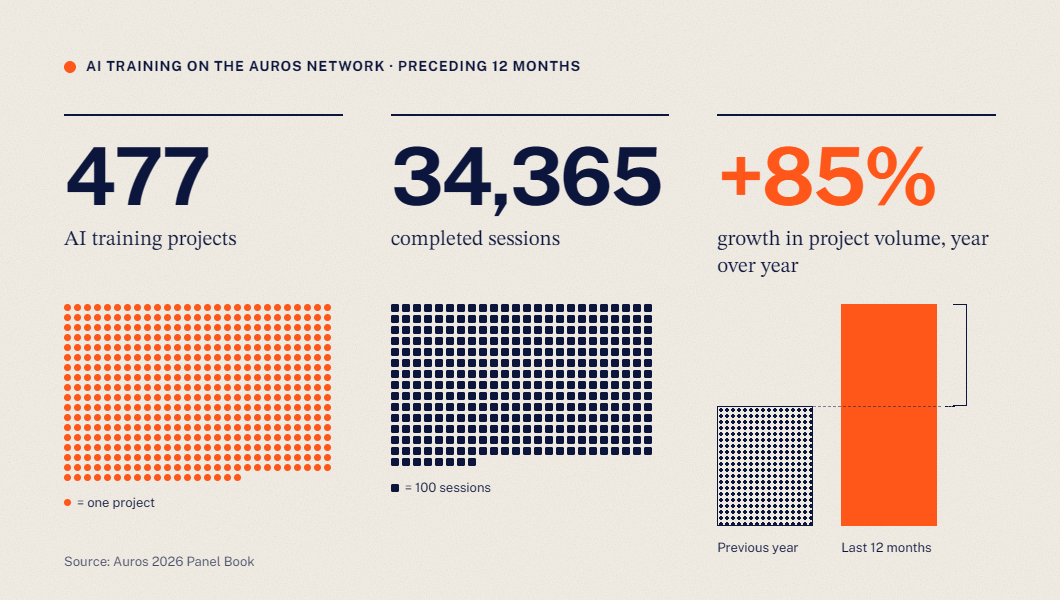
Those numbers reflect a shift in how organizations develop AI.
Human input can no longer be an occasional checkpoint. AI teams need dependable access to qualified people, whether that means thousands of consumers providing preference data or a handful of specialists evaluating high-stakes decisions.
Through User Interviews' AI training capabilities, teams can recruit specialized professionals, screen for relevant expertise, and connect recruitment to their development workflows through APIs.
For enterprise AI teams, testing AI experiences with real people adds another layer of evidence: whether systems work under realistic conditions, how people respond to errors, and whether agents earn enough trust to be used.
The challenge is to make these human contributions a repeatable part of AI development rather than something teams scramble to find when an evaluation exposes a problem.
Better AI doesn't come from removing humans from the process. It comes from involving the right humans, at the right moments, to teach AI what better actually means.